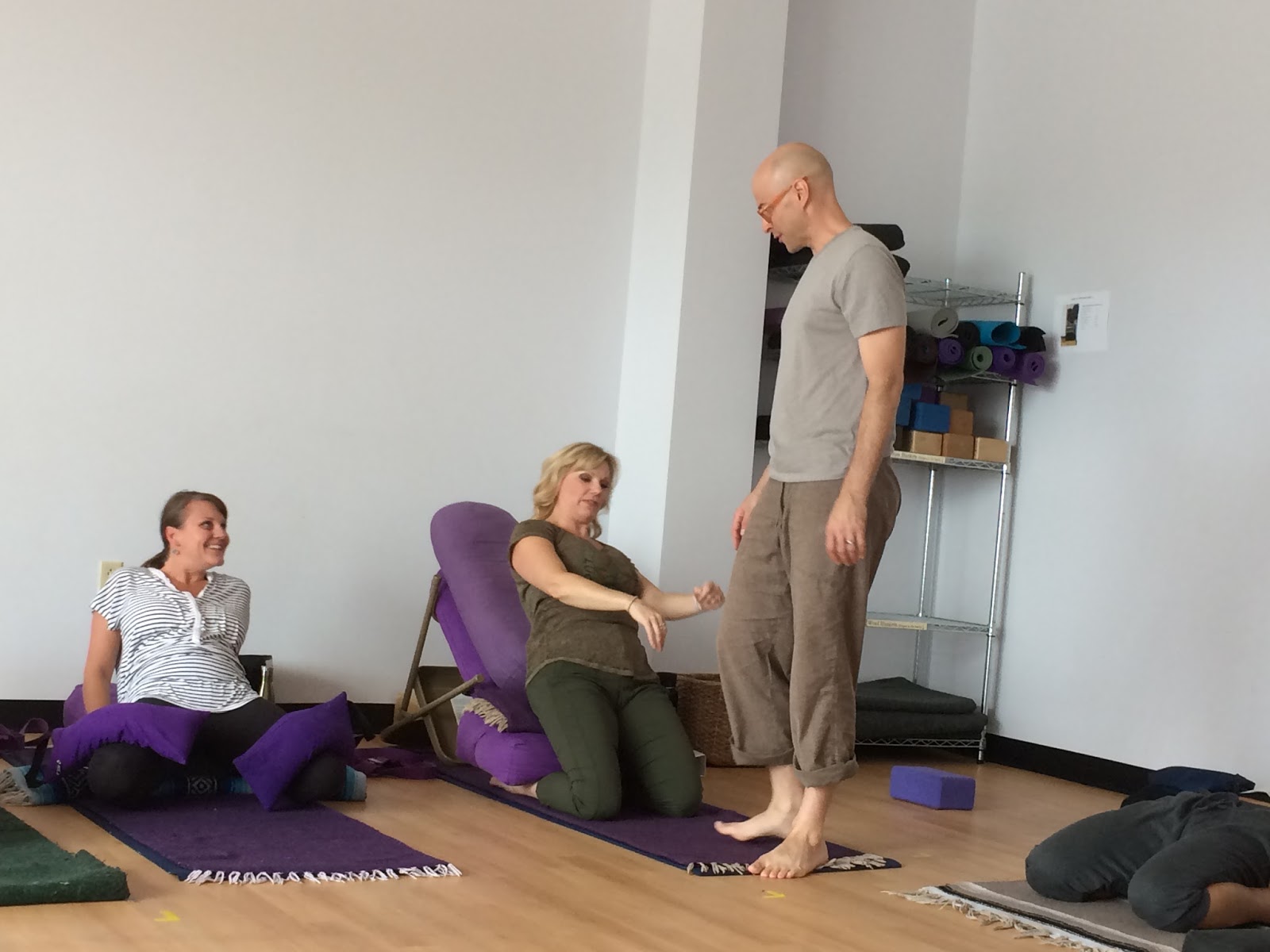
Yoga class training is now over. 18 weekends of training is completed. 180 hours of learning and practicing. Many hours of reading, studying, and preparing.
It seems like yesterday, on a somewhat cold February morning, that I first met with 15 other strangers nervous about what we were getting ourselves into. Its has been a challenging road, filled with many stops of learning along the way. I learned that I love anatomy but, for some reason, that I struggle to remember Latin names for muscles. I have learned that we become better Yoga teachers every time we get in front of a class, that our voice and style carries a lot of weight when we are leading a class, and that I have just scratched the surface of what I can learn about myself, the human body, movement, exercise, breathing, and teaching Yoga. I am more than glad to have the experience and I am sad that it has ended. I really enjoyed the company of my classmates.
I still have a final exam to complete, along with some other incidentals, but I now have every other weekend back. I will miss the camaraderie of my fellow students and the great pleasure it is to sit and and learn (with lots of Yoga breaks) . I forgot how wonderful it is to learn in a class setting. This, however, will not be the end of my Yoga education.
The last four weekends, our class has gone through several rounds of
practicums where we teach each other in 20 minute blocks and are
evaluated and receive constructive criticism. It was stressful (most of us taught four times) and necessary. What was taught ranged
from a quiet meditative to a fast flow to holding hard poses for several minutes in a strength focused practice. Each student brought their own imprint into what they taught. It was beautiful to see and wonderful to be part of.
Now comes the hard part. I have to take what I learned and try to see if I can teach. I would like to be able to volunteer my time to bring Yoga to those who may not have access to it and I for certain want to share the benefits of a Yoga practice with those in their middle age years and beyond. I am volunteer teaching one time a week now but I would like to add to that and make it something more permanent. I could always try to teach in a studio, but I am not certain I want to go that route. I do not look at Yoga as a way to earn money, but rather as a way to help people get healthy.
So the future holds a good amount of what ifs. That, however, is the nature of life. As the teacher who worked with us on meditation asked "Whose life has unfolded to be exactly they planned it to be". As I have said in earlier posts, I will practice Yoga until I cannot breath. The same will go with teaching.
Namaste.
Tuesday, October 31, 2017
Wednesday, October 4, 2017
Yoga and my darn knee.
When there is enough light in the evening, I like to walk a 4.5 mile loop (7.2 km) loop in a park near my house. During the summer, I sometimes walk the loop four or five times a week and it feels great for both the exercise and to enjoy the warmth, breeze and being out in the world. A few days ago, I got caught in a sudden cold and windy rainfall and the temperature dropped about ten degrees (from 70 F to 60 F) very quickly. I was about two miles from my car, dressed for nice weather, and pretty wet so I decided to run back to my car instead of walking. It felt good to run but as a result of this escapade, I now have a recurrence of my Runner's Knee (pain on the outside of the knee). Runner's Knee was one of the reasons I started practicing Yoga as I was looking for an alternative form of exercise that had less impact on my body.
I am now nursing knee pain for the past few days (including two days of Yoga instructor training) and somewhat regretting that I ran. Life, however, can only be lived forwards. I cannot take back those two miles and the joy and pain they brought me.
This recent knee pain has made me think about how great Yoga is for an aging body. Because a practice is best built around the needs of the individual, we can adjust our practice to how our body is working and changing. For myself, the beginning of my Yoga practice was all about headstands, working to get into challenging arm balances, and going to hot classes and sweating and moving. As I age, my practice has become slower, I am more focused on holding poses for longer, I devote less time to "Instagram" poses, and I am more mindful about the form of the poses I hold and my breath while holding them. I have adapted Yoga to my needs.
I was able to work around my knee pain by practicing a Yoga series focused on long restorative holds. While I did not sweat nor had any aerobic impact, the practice worked to release tension in my lower back, hips, abductors, shoulders and upper back. It was also quiet and restful and I felt great and peaceful afterwards. If Yoga was not in my life and my exercise was limited only to running or walking, then I would have no activity for three or four days and I would have been tempted to run or walk because of inactivity.
As we get older, our exercise needs to reflect that fact that our body needs more time to heal, cannot absorb impacts like running as easily as it once did, and needs to become more flexible. Yoga, because of its myriad of styles and thousands of poses, can be modified to the individual needs of each of us. While I personally think that Yoga needs to be combined with an aerobic activity like walking or hiking, it is the keystone for my exercise life. I will be practicing Yoga until my next rebirth.
Namaste
I am now nursing knee pain for the past few days (including two days of Yoga instructor training) and somewhat regretting that I ran. Life, however, can only be lived forwards. I cannot take back those two miles and the joy and pain they brought me.
This recent knee pain has made me think about how great Yoga is for an aging body. Because a practice is best built around the needs of the individual, we can adjust our practice to how our body is working and changing. For myself, the beginning of my Yoga practice was all about headstands, working to get into challenging arm balances, and going to hot classes and sweating and moving. As I age, my practice has become slower, I am more focused on holding poses for longer, I devote less time to "Instagram" poses, and I am more mindful about the form of the poses I hold and my breath while holding them. I have adapted Yoga to my needs.
I was able to work around my knee pain by practicing a Yoga series focused on long restorative holds. While I did not sweat nor had any aerobic impact, the practice worked to release tension in my lower back, hips, abductors, shoulders and upper back. It was also quiet and restful and I felt great and peaceful afterwards. If Yoga was not in my life and my exercise was limited only to running or walking, then I would have no activity for three or four days and I would have been tempted to run or walk because of inactivity.
As we get older, our exercise needs to reflect that fact that our body needs more time to heal, cannot absorb impacts like running as easily as it once did, and needs to become more flexible. Yoga, because of its myriad of styles and thousands of poses, can be modified to the individual needs of each of us. While I personally think that Yoga needs to be combined with an aerobic activity like walking or hiking, it is the keystone for my exercise life. I will be practicing Yoga until my next rebirth.
Namaste
Tuesday, September 12, 2017
Advice for New Yoga Students.
Thinking of Trying Yoga? Here are some tips for you.
Don't worry if you think you are not flexible enough. Yoga will help you with flexibility.
You get the same benefit out of Yoga as your super bendy friend. Its a personal practice.
Don't worry if you think you are not flexible enough. Yoga will help you with flexibility.
You get the same benefit out of Yoga as your super bendy friend. Its a personal practice.
Don't compare yourself to the person on the mat next to you. Your
Yoga practice is the few square feet of your mat. You are there for
the benefits to yourself.
Remember to breathe.
Honor your body.
Be present on the mat. Leave the past and the future off the mat.
Basic Yoga poses give you the best benefits. The hard Yoga poses are only useful on Instagram.
Get some basic pose knowledge before you venture into a public Yoga class. Look for beginner classes. There are also multitudes of beginner yoga videos on YouTube.
Pride will get you hurt. Humility will get you healthy. Practice Yoga within your comfortable and safe range of motion. The mentality of pushing it can cause injury.
You can achieve more than you think.
Namaste...
Remember to breathe.
Honor your body.
Be present on the mat. Leave the past and the future off the mat.
Basic Yoga poses give you the best benefits. The hard Yoga poses are only useful on Instagram.
Get some basic pose knowledge before you venture into a public Yoga class. Look for beginner classes. There are also multitudes of beginner yoga videos on YouTube.
Pride will get you hurt. Humility will get you healthy. Practice Yoga within your comfortable and safe range of motion. The mentality of pushing it can cause injury.
You can achieve more than you think.
Namaste...
Teaching Again..
Weeks 13 and 14 of training are now in the past. The classes are now focusing Practicums (where we teach the each other as a group and are critiqued) , practical items such as ethics and business, class sequencing, and some final Yoga topics like teaching back bends. With only four weekends to go, the ending of training will be soon upon us and I will be unleashed to the world.
From my perspective, 200 hours of training just scratches the surface of what there is needed to be learned. The amount of information is enormous and it is difficult to synthesize all of it. I have been taking time to review anatomy as remembering all of it is very difficult. I also have been working on a creating booklet of standard poses with steps to get in and out of the pose and cues while in the pose as a way of making sure I have a good mastery of each pose that I plan on teaching. I see now that learning about and teaching Yoga is a lifelong experience, and I have been putting a half an hour aside each day to learn something new.
I am starting up teaching free classes again. I am excited to teach and I am preparing as we speak. I will focus on introducing students to a number of poses, get them comfortable with those poses and then build on from there. I have been working on how to introduce people to harder poses while still allowing them to be safe and in control. It takes a great deal of time to build your first practices and I am really enjoying the work. I am very happy that I took the teacher training plunge. It was a great decision on my part.
Namaste.
From my perspective, 200 hours of training just scratches the surface of what there is needed to be learned. The amount of information is enormous and it is difficult to synthesize all of it. I have been taking time to review anatomy as remembering all of it is very difficult. I also have been working on a creating booklet of standard poses with steps to get in and out of the pose and cues while in the pose as a way of making sure I have a good mastery of each pose that I plan on teaching. I see now that learning about and teaching Yoga is a lifelong experience, and I have been putting a half an hour aside each day to learn something new.
I am starting up teaching free classes again. I am excited to teach and I am preparing as we speak. I will focus on introducing students to a number of poses, get them comfortable with those poses and then build on from there. I have been working on how to introduce people to harder poses while still allowing them to be safe and in control. It takes a great deal of time to build your first practices and I am really enjoying the work. I am very happy that I took the teacher training plunge. It was a great decision on my part.
Namaste.
Thursday, August 10, 2017
Yin Weekend... Week 12 of Teacher Training..
2/3 of training is complete.. Only 6 more weekends to go. Training, like life, is speeding by and before I know it, we will be taking our group photo and going our separate ways.
Week 12 was a two day Yin Yoga focused class. In Yin Yoga you hold poses longer and allow gravity and not active muscles to stretch in the pose. It gets deep into the fascia and ligaments in addition to your muscles. All poses are generally either seated or lying down and while many poses are shared with more active Yoga types, there are differences in how they are held and how some cues are given. There are also some poses that are pretty much Yin only. In my own practice, I hold most poses for three minutes but some for five minutes and a few for only one minute.
I have been practicing Yin for a long time, so the poses that we were taught in the class were mostly known to me though we did some poses that I was not familiar with (mostly subtle ones) . Our instructor provided a booklet with a number of poses that will be helpful along with my Yin book that I bought years ago. I love Yin and posted a sequence a few years ago here. Link to Older Post
We spent a very long time working on the concept of compression verses tension in the body. This concept was one of the greatest things I got out of my training. Basically, we are limited by poses either by tension (tightness in muscles) or compression (bone pressing on bone). If a person feels stretching in a pose (tension) , then they have room to progress in a pose. If a person feels compression in a pose (meaning bone is hitting bone), chances are they can never progress in that pose. While this may not a complete axiom (Did he just use Axiom in a sentence?) , it is good information to know when you are teaching a student. You can ask a student what they are feeling and if there is compression (for example in a forward fold they can feel their hips compressing and not tightness in their hamstrings), then they should not go so deep in that pose.
We also discussed what makes one person able to do a pose, while another cannot. For example, look at the photo below.
These are Femur bones. The ball on the top left of each bone go into the Pelvis (the hip socket known as the Acetabulum). You can see that the person on the left has less of an angle along the head of the bone and that the spur along the top right (known as the Greater Trochanter) is more pronounced. This photo shows that despite us being human, there is a range of difference in how we are structured. The person on the left will have a lesser range of motion when widening their legs than the person on the right and thus will be limited by their Femur construction in what is called abduction poses. The person on the right will be more able to do a split than the person on the left due to this difference. This is due to the fact that the person on the left may hit their pelvis with their legs abducted before they hit the limit of their muscle flexibility.
Another good take away from this class was how to approach a student in regards to how a pose should be done. Because Yin is a deep practice, a class could be varied in how deep each person can go into a pose. Because of age, injury, muscle flexibility, bone structure etc., we are all different and this effects how a person can do a pose. We need to ask a student where they are feeling something to determine how to adjust them. Are they feeling compression or tightness or pain? We need to be able (and learn how) to provide props and other adjustments to allow them to experience a pose. This is something that we have been learning all along but in the example photo below, you can see two modifications (on the left) and the part of a person (on the right) who has gone deep into a pose. The person on the right was so deep into the pose, that he actually had to be adjusted to go deeper into it.
What was interesting for me is that I have a limited external rotation of my legs (meaning how far can I rotate my feet out with my heels together before I hit compression) but I am able to do a full lotus (legs crossed over each other) and I can do a lying lotus (legs on the floor, crossed with my back flat on the floor). The human body is pretty amazing.
Overall, a great learning weekend. Probably the best one so far. I have to give credit to the teaching capabilities of the instructor. He did a great job explaining the points he wanted to get across.
Namaste.
Week 12 was a two day Yin Yoga focused class. In Yin Yoga you hold poses longer and allow gravity and not active muscles to stretch in the pose. It gets deep into the fascia and ligaments in addition to your muscles. All poses are generally either seated or lying down and while many poses are shared with more active Yoga types, there are differences in how they are held and how some cues are given. There are also some poses that are pretty much Yin only. In my own practice, I hold most poses for three minutes but some for five minutes and a few for only one minute.
I have been practicing Yin for a long time, so the poses that we were taught in the class were mostly known to me though we did some poses that I was not familiar with (mostly subtle ones) . Our instructor provided a booklet with a number of poses that will be helpful along with my Yin book that I bought years ago. I love Yin and posted a sequence a few years ago here. Link to Older Post
We spent a very long time working on the concept of compression verses tension in the body. This concept was one of the greatest things I got out of my training. Basically, we are limited by poses either by tension (tightness in muscles) or compression (bone pressing on bone). If a person feels stretching in a pose (tension) , then they have room to progress in a pose. If a person feels compression in a pose (meaning bone is hitting bone), chances are they can never progress in that pose. While this may not a complete axiom (Did he just use Axiom in a sentence?) , it is good information to know when you are teaching a student. You can ask a student what they are feeling and if there is compression (for example in a forward fold they can feel their hips compressing and not tightness in their hamstrings), then they should not go so deep in that pose.
We also discussed what makes one person able to do a pose, while another cannot. For example, look at the photo below.
These are Femur bones. The ball on the top left of each bone go into the Pelvis (the hip socket known as the Acetabulum). You can see that the person on the left has less of an angle along the head of the bone and that the spur along the top right (known as the Greater Trochanter) is more pronounced. This photo shows that despite us being human, there is a range of difference in how we are structured. The person on the left will have a lesser range of motion when widening their legs than the person on the right and thus will be limited by their Femur construction in what is called abduction poses. The person on the right will be more able to do a split than the person on the left due to this difference. This is due to the fact that the person on the left may hit their pelvis with their legs abducted before they hit the limit of their muscle flexibility.
Another good take away from this class was how to approach a student in regards to how a pose should be done. Because Yin is a deep practice, a class could be varied in how deep each person can go into a pose. Because of age, injury, muscle flexibility, bone structure etc., we are all different and this effects how a person can do a pose. We need to ask a student where they are feeling something to determine how to adjust them. Are they feeling compression or tightness or pain? We need to be able (and learn how) to provide props and other adjustments to allow them to experience a pose. This is something that we have been learning all along but in the example photo below, you can see two modifications (on the left) and the part of a person (on the right) who has gone deep into a pose. The person on the right was so deep into the pose, that he actually had to be adjusted to go deeper into it.
What was interesting for me is that I have a limited external rotation of my legs (meaning how far can I rotate my feet out with my heels together before I hit compression) but I am able to do a full lotus (legs crossed over each other) and I can do a lying lotus (legs on the floor, crossed with my back flat on the floor). The human body is pretty amazing.
Overall, a great learning weekend. Probably the best one so far. I have to give credit to the teaching capabilities of the instructor. He did a great job explaining the points he wanted to get across.
Namaste.
Friday, July 28, 2017
Weeks 9, 10, and 11 of Teacher Training.
Class are sure going fast.. 11 down and 7 more to go.
Age does catch up to me as I went to a hot class about 2 weeks ago and pulled my Psoas. The Psoas is a muscle that runs from your lower spine over your pelvis and attaches to the front of your femur. It is used for stability and in our society it is a weak muscle because of the amount of sitting we do. It was able to treat my injury with my Tens device (the Aleve Tens device is great) to practice Yoga (though not flow) within a few days. I have to say that the teacher was too fast on her cues for moving between poses and that may have caused it. I was not able to move from pose to pose within my breath and I felt rushed and I felt that my transitions between poses were not smooth. I believe that each pose needs to be completed within a four count breath and I always practice that way. I plan to teach a smooth and easy flow from pose to pose. Ease into the pose is my mantra. You get the benefit of the pose.. Yoga is not aerobics and the fashion is much better.
I am now more than half way through my training. It is amazing to realize how little I knew about the human body, movement, and Yoga and how much I have learned and how that much more I still will have to learn. The ability to link movement to anatomy has especially been a challenge because of the complex nature of our muscles and my ability to visualize those movements with muscles. We have been given assignment to work through and it has been difficult but enlightening. I think it is critical for a teacher to have a good grasp of the anatomy of poses so they can teach them properly so I will always work on learning more about anatomy and movement.
The focus in our classes during the past three weekends was somewhat varied but mainly focused on anatomy, sequencing and different types of Yoga. We have been working on class sequencing, understanding how to best support a student in a pose so that they are comfortable with it, and how to build a class to either an apex pose or a theme.
Two classes were about upper body therapy (which was really good) and a style of Yoga called Kundalini. I really enjoyed both of these sessions as the subject matter was new to me. I think I will be incorporating some of the Kundalini concepts into my classes (especially some poses and breath work) as I liked the strenuous but non-threatening nature of the poses. The upper body therapy class was good because we took difficult poses and made them accessible using blocks, straps and other props. Not everyone can do a difficult pose, but with modifications, they can get the benefit from what the pose offers.
I am still not too happy about the lack of us teaching each other. I was under the impression that this was going to happen but it has not. I think many of us need the feedback about how we teach and right now that need is not fulfilled. I suggested to our class that we ask for a day where we spend teaching each other but there is not full agreement yet on this. I am lucky that I have been able to teach students, many of us have not and I think completing the program and then teaching for the first time in a studio is not optimal.
Namaste.
Age does catch up to me as I went to a hot class about 2 weeks ago and pulled my Psoas. The Psoas is a muscle that runs from your lower spine over your pelvis and attaches to the front of your femur. It is used for stability and in our society it is a weak muscle because of the amount of sitting we do. It was able to treat my injury with my Tens device (the Aleve Tens device is great) to practice Yoga (though not flow) within a few days. I have to say that the teacher was too fast on her cues for moving between poses and that may have caused it. I was not able to move from pose to pose within my breath and I felt rushed and I felt that my transitions between poses were not smooth. I believe that each pose needs to be completed within a four count breath and I always practice that way. I plan to teach a smooth and easy flow from pose to pose. Ease into the pose is my mantra. You get the benefit of the pose.. Yoga is not aerobics and the fashion is much better.
I am now more than half way through my training. It is amazing to realize how little I knew about the human body, movement, and Yoga and how much I have learned and how that much more I still will have to learn. The ability to link movement to anatomy has especially been a challenge because of the complex nature of our muscles and my ability to visualize those movements with muscles. We have been given assignment to work through and it has been difficult but enlightening. I think it is critical for a teacher to have a good grasp of the anatomy of poses so they can teach them properly so I will always work on learning more about anatomy and movement.
The focus in our classes during the past three weekends was somewhat varied but mainly focused on anatomy, sequencing and different types of Yoga. We have been working on class sequencing, understanding how to best support a student in a pose so that they are comfortable with it, and how to build a class to either an apex pose or a theme.
Two classes were about upper body therapy (which was really good) and a style of Yoga called Kundalini. I really enjoyed both of these sessions as the subject matter was new to me. I think I will be incorporating some of the Kundalini concepts into my classes (especially some poses and breath work) as I liked the strenuous but non-threatening nature of the poses. The upper body therapy class was good because we took difficult poses and made them accessible using blocks, straps and other props. Not everyone can do a difficult pose, but with modifications, they can get the benefit from what the pose offers.
I am still not too happy about the lack of us teaching each other. I was under the impression that this was going to happen but it has not. I think many of us need the feedback about how we teach and right now that need is not fulfilled. I suggested to our class that we ask for a day where we spend teaching each other but there is not full agreement yet on this. I am lucky that I have been able to teach students, many of us have not and I think completing the program and then teaching for the first time in a studio is not optimal.
Namaste.
Friday, June 16, 2017
Teaching Yoga will always be a Challenge / Week 8 of Training
My five week Yoga teaching session is over. It was a great experience and I looked forward to 7:00 on Thursdays with great anticipation. I averaged about 12 people a class and I introduced the students to about 40 poses over course of the five weeks. I really like to focus my own practice on both strength and flexibility, and that is what I tried to focus on during my classes. Since I had the luxury of an hour and a half, I was able to do a good amount of teaching and demonstrating while allowing everyone to have plenty of time to practice the poses. During the last class, I tried to just lead the class through a Yoga practice without doing any demonstrating and it was good to see how they all knew the poses and were able to follow along for the most part. My goals were to introduce everyone to Yoga and to prepare them to go to a class at a studio and be comfortable in doing so. I think I accomplished both of these goals. If just one person continues with a Yoga practice, I will consider myself more than successful.
I learned a lot about teaching and myself over the past five weeks. The biggest take away for me is that you cannot prepare enough for classes. I constantly refined what I wanted to teach and went through my class plan in my home Yoga room a few times before each class. Even then, I had to refer to my notes for the next pose or a cue that I wrote down at times. I have to learn how to better cue poses comfortably and with ease and to be more concise and remember each step in a pose or a flow. More than a few times I missed a step or a piece of a flow or a pose. I also realize that I have to better understand how to notice , approach, and teach adjustments to individuals while I have a everyone in a pose. I will have to get more proficient about why we do poses and how they impact our body. This should will come with study and time and it is good to have a direction to take my learning. Finally, I have to be focused on what I am saying. People are really focusing on your words and I owe it to them to be clear and concise as I felt sometimes I was not.
I was pretty up front with everyone about using these classes as an opportunity to become a better teacher and I really appreciate the fact that everyone was open to that. I told them a few times that I am trying something out and they more than obliged. There is no better teacher than experience.
Week 8 of training is 2 weeks in the past. We spent a great Saturday working on lower body therapy and simulating difficult poses using props. We started the class going through about 10 poses described in the "Light on Yoga" book but BKS Iyengar. His descriptions are very technical and very focused on getting into the highest level of a pose. We then took these 10 poses and worked them through using props and alternatives set ups. It was really great to see how using blocks, bolsters, or straps a person can get the same benefit from a modified pose as they can from the "harder' version of that pose.
Our Sunday was spent on looking at the front body line and working through a sequence addressing those muscles and ligaments. We also spent a good amount of time building a sequence toward an assigned "Apex" pose. An Apex pose it generally the hardest pose in a class and the class should be set up in such a way as to prepare the students for that pose. The take away for me is that the
sequence that is built needs to get the body ready for the Apex pose and that all cues used in the Apex pose should already be used in previous poses within the sequence. It was sort of an "aha" moment.
By the end of the weekend, after 6 - 7 hours of Yoga, I was sore in more than a few places. A good sore, but sore none the less.
Namaste.
I learned a lot about teaching and myself over the past five weeks. The biggest take away for me is that you cannot prepare enough for classes. I constantly refined what I wanted to teach and went through my class plan in my home Yoga room a few times before each class. Even then, I had to refer to my notes for the next pose or a cue that I wrote down at times. I have to learn how to better cue poses comfortably and with ease and to be more concise and remember each step in a pose or a flow. More than a few times I missed a step or a piece of a flow or a pose. I also realize that I have to better understand how to notice , approach, and teach adjustments to individuals while I have a everyone in a pose. I will have to get more proficient about why we do poses and how they impact our body. This should will come with study and time and it is good to have a direction to take my learning. Finally, I have to be focused on what I am saying. People are really focusing on your words and I owe it to them to be clear and concise as I felt sometimes I was not.
I was pretty up front with everyone about using these classes as an opportunity to become a better teacher and I really appreciate the fact that everyone was open to that. I told them a few times that I am trying something out and they more than obliged. There is no better teacher than experience.
Week 8 of training is 2 weeks in the past. We spent a great Saturday working on lower body therapy and simulating difficult poses using props. We started the class going through about 10 poses described in the "Light on Yoga" book but BKS Iyengar. His descriptions are very technical and very focused on getting into the highest level of a pose. We then took these 10 poses and worked them through using props and alternatives set ups. It was really great to see how using blocks, bolsters, or straps a person can get the same benefit from a modified pose as they can from the "harder' version of that pose.
Our Sunday was spent on looking at the front body line and working through a sequence addressing those muscles and ligaments. We also spent a good amount of time building a sequence toward an assigned "Apex" pose. An Apex pose it generally the hardest pose in a class and the class should be set up in such a way as to prepare the students for that pose. The take away for me is that the
sequence that is built needs to get the body ready for the Apex pose and that all cues used in the Apex pose should already be used in previous poses within the sequence. It was sort of an "aha" moment.
By the end of the weekend, after 6 - 7 hours of Yoga, I was sore in more than a few places. A good sore, but sore none the less.
Namaste.
Subscribe to:
Posts (Atom)